

Protecting Your Baby from RSV: Protection During Pregnancy or Protection After Birth
Download PDF | Leer en español
Protecting Your Baby from RSV: Protection During Pregnancy or Protection After Birth (Text Version)
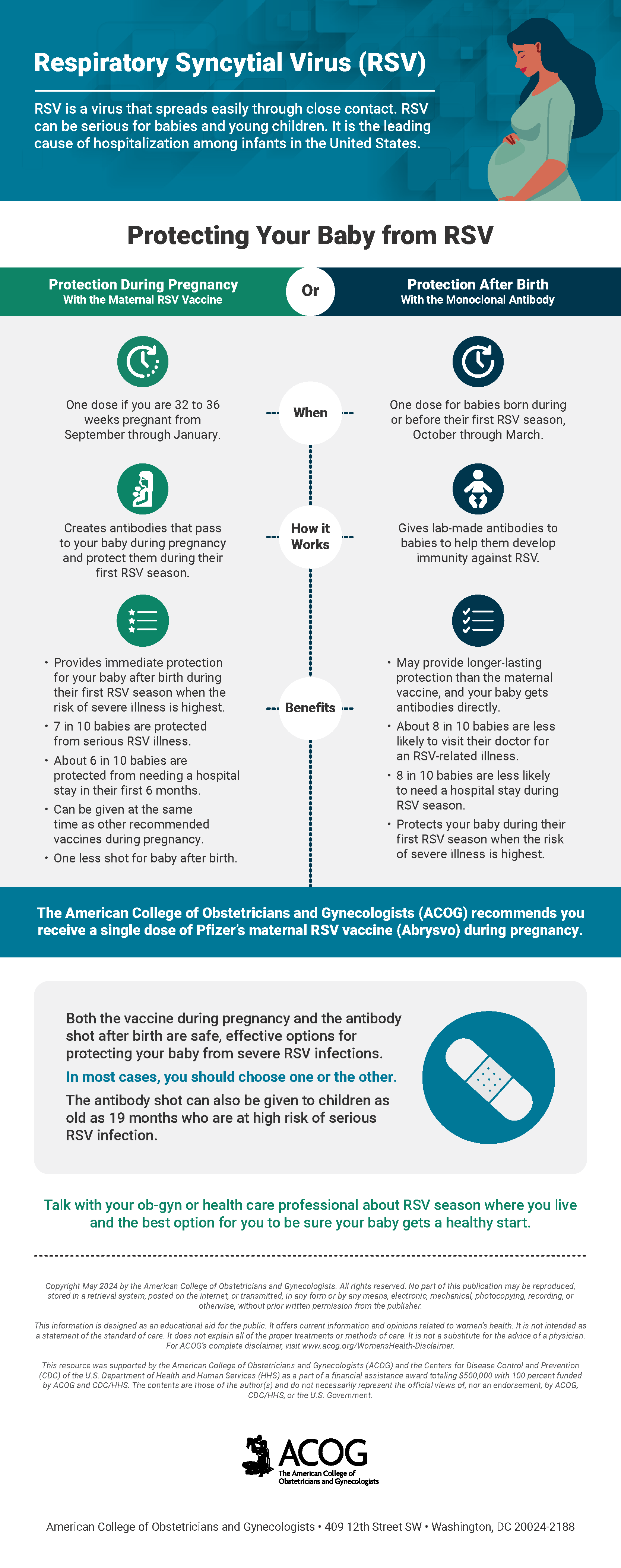
Respiratory Syncytial Virus (RSV) is a virus that spreads easily through close contact. RSV can be serious for babies and young children. It is the leading cause of hospitalization among infants in the United States.
Protecting Your Baby from RSV
Maternal RSV Vaccine (Abrysvo)
When: One dose if you are 32 to 36 weeks pregnant from September through January.
How it works: Creates antibodies that pass on to your baby during pregnancy and protects them during their first RSV season.
Benefits:
Provides immediate protection for your baby after birth.
7 in 10 babies are protected from serious RSV illness.
About 6 in 10 babies are protected from needing a hospital stay in their first 6 months.
Can be given at the same time as other recommended vaccines during pregnancy.
One less shot for baby after birth.
Newborn Monoclonal Antibody (Nirsevimab)
When: One dose for babies born during or before their first RSV season, September through January.
How it works: Gives lab-made antibodies to babies to help them develop immunity against RSV.
Benefits:
May provide longer-lasting protection than the maternal vaccine, and your baby gets antibodies directly.
About 8 in 10 babies are less likely to visit their doctor for an RSV-related illness.
8 in 10 babies are less likely to need a hospital stay during RSV season.
Protects your baby during their first RSV season when the risk of severe illness is highest.
Both the vaccine during pregnancy and the antibody shot after birth are safe, effective options for protecting your baby from severe RSV infections. In most cases, you should choose one or the other.
The antibody shot can also be given to children as old as 19 months who are at high risk of serious RSV infection.
The American College of Obstetricians and Gynecologists (ACOG) recommends you receive a single dose of Pfizer’s maternal RSV vaccine (Abrysvo) during pregnancy.
Talk with your ob-gyn or health care professional about the best option for you to ensure a healthy start for your baby.
This information is designed as an educational aid for the public. It offers current information and opinions related to women’s health. It is not intended as a statement of the standard of care. It does not explain all of the proper treatments or methods of care. It is not a substitute for the advice of a physician. For ACOG’s complete disclaimer, visit www.acog.org/WomensHealth-Disclaimer.
Copyright February 2024 by the American College of Obstetricians and Gynecologists. All rights reserved. No part of this publication may be reproduced, stored in a retrieval system, posted on the internet, or transmitted, in any form or by any means, electronic, mechanical, photocopying, recording, or otherwise, without prior written permission from the publisher.
This resource was supported by the American College of Obstetricians and Gynecologists (ACOG) and the Centers for Disease Control and Prevention (CDC) of the U.S. Department of Health and Human Services (HHS) as a part of a financial assistance award totaling $500,000 with 100 percent funded by ACOG and CDC/HHS. The contents are those of the author(s) and do not necessarily represent the official views of, nor an endorsement, by ACOG, CDC/HHS, or the U.S. Government.
Published: September 2024
Last reviewed: September 2024
Copyright 2026 by the American College of Obstetricians and Gynecologists. All rights reserved. Read copyright and permissions information.
This information is designed as an educational aid for the public. It offers current information and opinions related to women's health. It is not intended as a statement of the standard of care. It does not explain all of the proper treatments or methods of care. It is not a substitute for the advice of a physician. Read ACOG’s complete disclaimer.