
Number 6 (Replaces Committee Opinion Number 532, August 2012)
Committee on Clinical Consensus–Gynecology. This Clinical Consensus was developed by the American College of Obstetricians and Gynecologists’ Committee on Clinical Consensus–Gynecology in collaboration with Amy J. Park, MD, and Belinda Yauger, MD.
The American Society for Reproductive Medicine endorses this document.
Summary: Many compounding pharmacies use the phrase “bioidentical hormone” as a marketing term to imply that these preparations are natural and, thus, safer and more effective than U.S. Food and Drug Administration (FDA)–approved menopausal medications that use bioidentical or synthetic hormones or both. However, evidence to support marketing claims of safety and effectiveness is lacking. Compounded bioidentical menopausal hormone therapy should not be prescribed routinely when FDA-approved formulations exist. Clinicians should counsel patients that FDA-approved menopausal hormone therapies are recommended for the management of menopausal symptoms over compounded bioidentical menopausal hormone therapy. If a patient requests the use of compounded bioidentical menopausal hormone therapy, clinicians should educate them on the lack of FDA approval of these preparations and their potential risks and benefits, including the risks specific to compounding. To truly understand the benefits and harms of compounded bioidentical menopausal hormone therapy, high quality placebo-controlled randomized controlled trials with long-term follow-up comparing custom-compounded products with FDA-approved menopausal hormone therapy are needed.
Background
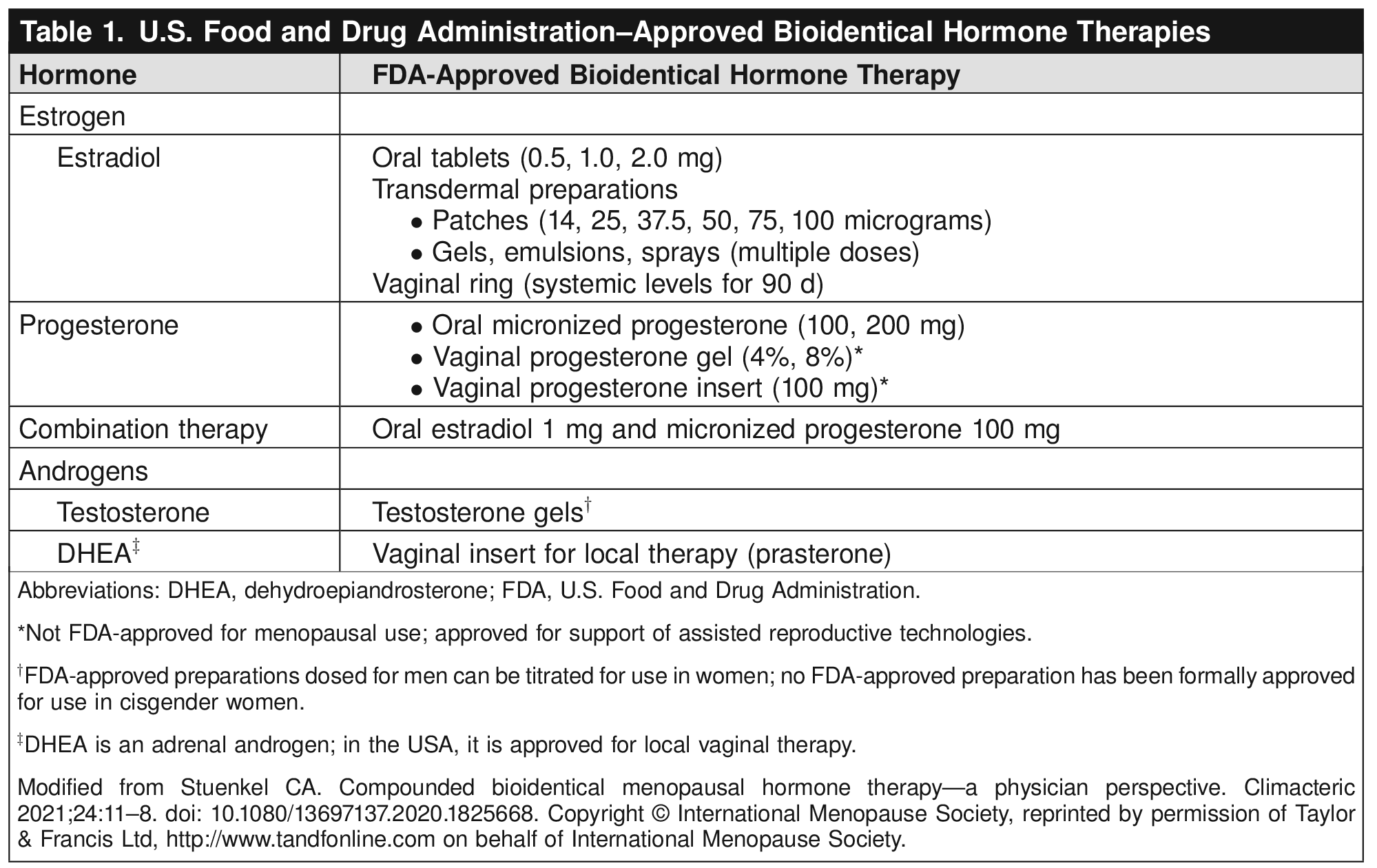
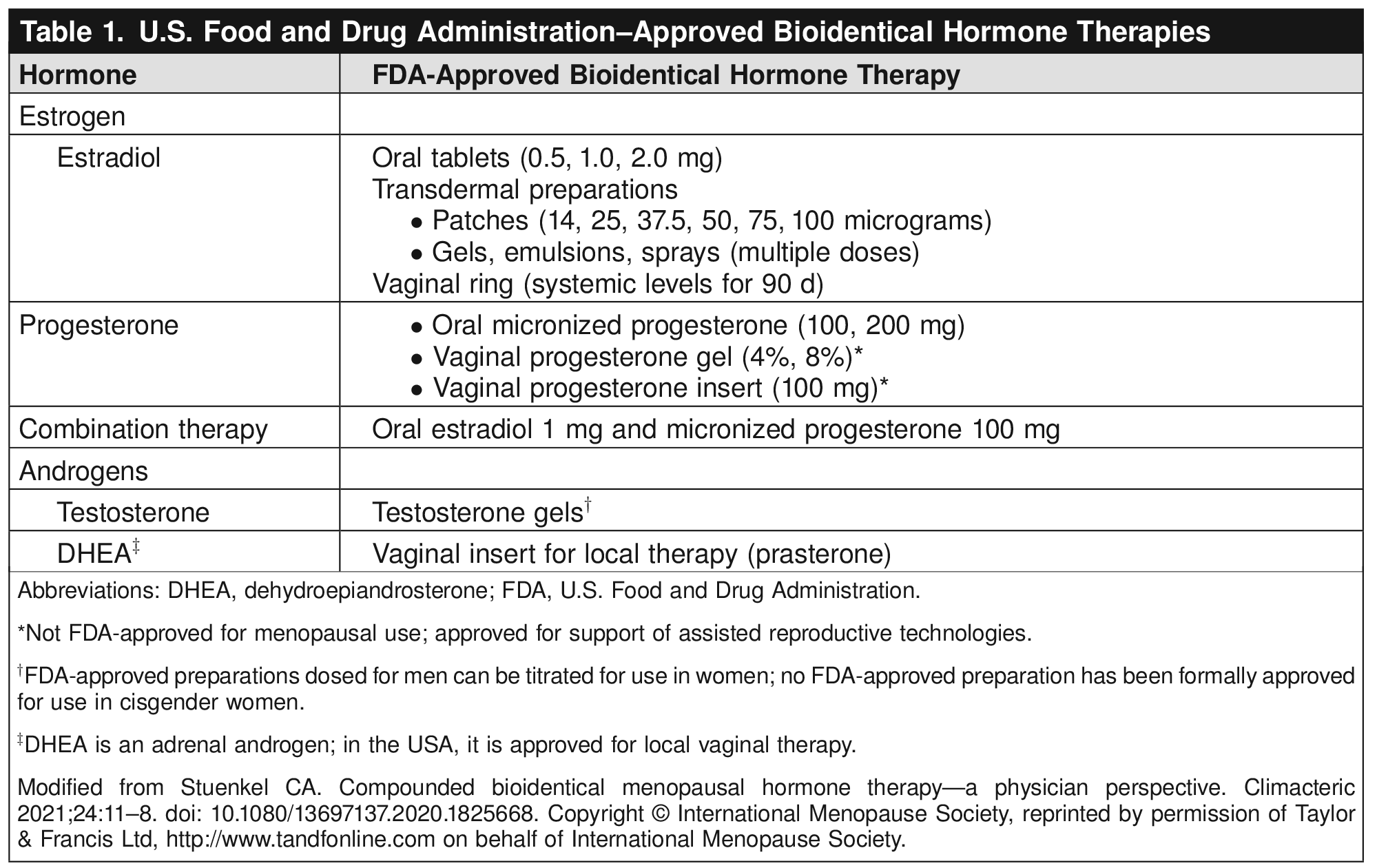
Bioidentical hormones are plant-derived hormones that are chemically similar or structurally identical to those produced by the body. These hormones include commercially available products approved by the U.S. Food and Drug Administration (FDA), such as micronized progesterone, estradiol, and dehydroepiandrosterone (DHEA), as well as compounded preparations that are not regulated by the FDA. Other preparations of compounded bioidentical menopausal hormone therapy include estrone, estradiol cypionate, estriol, pregnenolone, testosterone, testosterone cypionate, and testosterone propionate 2.
Compounded bioidentical hormones are made from a clinician’s prescription and are available in various routes of administration, including oral, sublingual, and percutaneous, or as implants, injectables, and suppositories. Unlike drugs that are approved by the FDA to be manufactured and sold in standardized dosages, compounded preparations often are custom-made for a patient according to a clinician’s specifications. The American College of Obstetricians and Gynecologists (ACOG) recognizes that the use of compounded medications may be appropriate for some patients and in some circumstances. Traditionally, compounding is used to provide treatment for patients when the exact products needed are not commercially available or when different ingredients, preservatives, or routes of administration are required because of patient intolerances (eg, allergy) or needs (eg, inability to swallow an oral pill). For example, there is an FDA-approved progesterone product that contains peanut oil. A prescription to compound progesterone to eliminate the peanut oil can allow a patient with a peanut allergy to use the drug safely. Additionally, cost and access concerns may prompt consideration of compounded vaginal formulations of estrogen or progesterone, for which the quality control regarding potency and vehicle (cream or ointment) should be discussed with the compounding pharmacy. Far removed from the traditional uses of compounding is the practice of blending commercially available drug products in proportions tailored to an individual patient. Many compounded bioidentical menopausal hormone therapy preparations fall into this category. This document focuses specifically on the use of compounded bioidentical menopausal hormone therapy, not compounding for other evidence-based reasons. This topic has been updated to include more recent data and additional therapies, including the use of testosterone for the management of menopausal symptoms.
The Role of the U.S. Food and Drug Administration
Compounding pharmacies that provide drugs based on a patient-specific prescription generally fall under Section 503A of the Federal Food Drug and Cosmetic Act This Clinical Consensus document was developed using an a priori protocol in conjunction with the authors listed above. The a priori protocol was modeled after the Clinical Consensus methodology; a full description of the Clinical Consensus methodology is published separately 4. The description below is specific to this Clinical Consensus document.
A literature search was performed from 2000 to November 2021 for clinical elements as noted in the outline. ACOG medical librarians searched Cochrane Library, Cochrane Collaboration Registry of Controlled Trials, EMBASE, PubMed, and MEDLINE for human-only studies written in English. MeSH terms and keywords can be found in Appendix 1 (available online at
http://links.lww.com/AOG/D389). Search terms for racial and ethnic disparities were incorporated into the literature review, and recommendations were drafted with the intent of promoting health equity and reducing these disparities. A bridge literature search was completed in April 2023. Any updated literature was incorporated into the text and recommendations, as appropriate.
Qualifying studies passed both title and abstract screen and full-text screen and met the following inclusion criteria: conducted in countries ranked very high on the United Nations Human Development Index http://links.lww.com/AOG/D390).
At a meeting of the Committee on Clinical Consensus–Gynecology, a quorum of two-thirds of eligible voting members was met, and the committee held a formal vote for each proposed recommendation. All recommendation statements met or exceeded the 75% approval threshold required for consensus. The American College of Obstetricians and Gynecologists recognizes and supports the gender diversity of all patients who seek obstetric and gynecologic care. In original portions of this document, authors seek to use gender-inclusive language or gender-neutral language. When describing research findings, this document uses gender terminology reported by investigators. To review ACOG’s policy on inclusive language, see
https://www.acog.org/clinical-information/policy-and-position-statements/statements-of-policy/2022/inclusive-language.
Methods
Literature Search
Study Selection
Consensus Voting and Recommendation Development
Use of Language
Summary of Consensus Recommendations
Safety and Efficacy of Custom-Compounded Hormone Therapy
There is a lack of high-quality data on the safety and efficacy of custom-compounded bioidentical hormone therapy for the management of menopausal symptoms. Compounded bioidentical menopausal hormone therapy should not be prescribed routinely when FDA-approved formulations exist.
There is no FDA-approved testosterone formulation for the management of menopausal symptoms. Clinicians and patients should use a shared decision-making framework when considering the use of compounded testosterone for this indication. Based on the lack of safety data and inability to remove the pellet, ACOG recommends preparations other than pellet therapy for the delivery of testosterone.
Accuracy of Hormone Level Testing
Data on the interpretation of adjunct hormone tests for prescribing and dosing compounded bioidentical menopausal hormone therapy are limited; thus, these tests are not recommended for these indications.
Patient Counseling
Clinicians should counsel patients that FDA-approved menopausal hormone therapies are recommended for the management of menopausal symptoms over compounded bioidentical menopausal hormone therapy preparations.
If a patient requests the use of compounded bioidentical menopausal hormone therapy, clinicians should educate them on the lack of FDA approval of these preparations and their potential risks and benefits, including the risks specific to compounding.
ACOG, American College of Obstetricians and Gynecologists; FDA, U.S. Food and Drug Administration.
Safety and Efficacy of Custom-Compounded Hormone Therapy
There is a lack of high-quality data on the safety and efficacy of custom-compounded bioidentical hormone therapy for the management of menopausal symptoms. Compounded bioidentical menopausal hormone therapy should not be prescribed routinely when FDA-approved formulations exist.
Evaluation of the published data regarding the efficacy and safety of compounded bioidentical menopausal hormone therapy is hindered by an overall lack of high-quality evidence. Many of the data are based on observational studies without a control group and that predominantly evaluated only short-term outcomes (less than 1 year) and often studied surrogate markers. A 2004 Cochrane Review of menopausal hormone therapy noted a 57.7% reduction in hot flushes within the placebo group alone, demonstrating the necessity of a control group, particularly when studying menopausal symptoms 6. Additionally, due to the inherent nature of custom-compounded medications, there is significant variability in the mixture of hormones included as well as differences in the route of administration and dosing. Many studies included a variety of routes of administration, so outcomes on the efficacy of oral compared with vaginal compared with topical administration, for instance, may be difficult to determine. Due to lack of regulation, the amount of active medication can be highly variable within a specific dose, which has been confirmed with independent testing 7. Finally, there are no requirements for adverse event reporting, which hinders a definitive evaluation of safety.
There are numerous observational and uncontrolled studies evaluating the effect of compounded bioidentical menopausal hormone therapy, with overall poor study quality and minimal symptom relief. A retrospective survey of women using compounded bioidentical products of many different formulations (n=70) compared with those using synthetic hormone therapy (n=53) reported improvements in sleep problems and dry skin with the use of compounded products 8. However, the study presented no statistical comparison and did not control for differences at baseline. Another survey of 184 patients found that menopausal symptom relief was similar between users of compounded bioidentical menopausal hormone therapy (preparations included estrogen, progesterone, and testosterone, and routes of administration included oral, transdermal, and buccal) and conventional therapy users; however, relief of sexual symptoms was reported more frequently in bioidentical menopausal compounded hormone therapy users than in those using conventional menopausal hormone therapy (78% vs 33%, P<.001) 9. Another systematic review that identified three randomized controlled trials (RCTs) on the use of bioidentical progesterone cream concluded that available evidence did not support its benefit for management of vasomotor symptoms 10.
Data on the safety of compounded bioidentical menopausal hormone therapy also are minimal and evaluate only surrogate markers. A 2022 systematic review and meta-analysis of only RCTs included studies comparing primarily short-term use of compounded bioidentical menopausal hormone therapy with placebo and found that bioidentical products were not associated with adverse changes in lipid profile or glucose metabolism 11. None of the RCTs (the longest duration of study was 1 year) that assessed endometrial thickness showed a significant difference between compounded bioidentical menopausal hormone therapy and either placebo or FDA-approved products. Compounded DHEA (including both oral and vaginal formulations) was associated with a higher risk of androgenic effects compared with placebo (relative risk 3.87, 95% CI 1.28–11.65). In this systematic review of short-term studies, no other compounded bioidentical menopausal hormone therapy products were associated with an increased risk of other adverse events. However, data were inadequate to assess the risk of breast cancer, endometrial cancer, or cardiovascular disease with the use of compounded bioidentical menopausal hormone therapy.
Studies have attempted to characterize the accuracy of dosing of different hormones within compounded hormone prescriptions. A study that evaluated prescriptions for combined estradiol and progesterone capsules and creams from 13 custom-compounding pharmacies found variability across pharmacies and within batches 12. The majority of products made by the pharmacies were within 10% of the label claim. However, levels could be as much as 26% below label for estradiol and 31% above label for progesterone. Some compounding pharmacies have attempted to standardize compounding of bioidentical menopausal hormone therapy by requiring their participating pharmacies to submit random quarterly samples to an independent third-party testing laboratory. In addition to the variability of dosing, compounded prescriptions include the potential for bacterial contamination 7.
There is no FDA-approved testosterone formulation for the management of menopausal symptoms. Clinicians and patients should use a shared decision-making framework when considering the use of compounded testosterone for this indication. Based on the lack of safety data and inability to remove the pellet, ACOG recommends preparations other than pellet therapy for the delivery of testosterone.
Compounded testosterone often is included in, or is the primary component of, compounded bioidentical menopausal hormone therapy. Currently, there is no FDA-approved testosterone formulation for cisgender women. There is an FDA-approved formulation of DHEA, as well as FDA-approved testosterone products for cisgender men. The American College of Obstetricians and Gynecologists' guidance on female sexual dysfunction notes that short-term use of transdermal testosterone can be considered as a treatment option for postmenopausal individuals with sexual interest and arousal disorders who have been appropriately counseled about the potential risks and unknown long-term effects 13. The most commonly reported adverse events noted with testosterone therapy in cisgender women included hirsutism, acne, and virilization, which may be irreversible. The effects of long-term use of testosterone on cardiovascular disease and breast cancer risk are unknown.
A 2022 systematic review of RCTs on compounded bioidentical hormone therapy found that testosterone and DHEA, both vaginally delivered, compared with placebo demonstrated a significant improvement in vaginal atrophy in symptomatic postmenopausal women (standardized mean difference −0.66, 95% CI −1.28 to −0.04) 11. Dosages were highly variable, ranging from 300 micrograms to 5 mg; treatment duration ranged from 1 month to 6 months; and follow-up ranged from 2 weeks to 1 year. No significant benefit for bone mineral density was demonstrated. Combining the vaginal testosterone or vaginal DHEA subgroups demonstrated significant improvements in arousal, lubrication, satisfaction, pain, and the overall Female Sexual Function Index score compared with placebo. There was no significant association between oral DHEA and improved total sexual function scores.
An increasingly popular treatment, testosterone pellet therapy, has the potential for better bioavailability and more predictable absorption when compared with intramuscular injection or patches 14. However, unlike other preparations that can be easily discontinued (eg, topical creams and pills), the pellet is not designed to be removed, but instead to dissolve over time. Generally, new pellets are inserted every 3 to 6 months. This route of administration potentially exposes the user to testosterone over a longer period of time compared with oral or topical products. A study of premenopausal (n=108) and postmenopausal (n=192) women treated with compounded testosterone pellet therapy reported statistically significant improvements in each of the 11 Menopause Rating Scale symptom categories over a mean follow-up of 28.1 months compared with pretreatment levels 15. Although data on androgenic adverse effects were not collected by the authors, they reported no adverse drug events. Other studies of testosterone pellets in premenopausal and postmenopausal women have reported adverse effects such as increases in facial hair and acne, perceived voice changes, mood swings, anxiety, weight gain, acute uterine bleeding, and hysterectomy secondary to abnormal uterine bleeding 16 17 18. In a retrospective analysis of a proprietary compounded testosterone pellet product that included cisgender men and both premenopausal and postmenopausal cisgender women (54% were premenopausal), 43% of patients discontinued therapy after the first insertion 14. How the study collected and described data is unclear; however, reported complications from insertion (extrusion, cellulitis, and bleeding) appeared to be low. Unfortunately, adverse effects of testosterone use were not assessed.
A major safety concern about testosterone therapy is a potential increased risk of invasive breast cancer. The effects of long-term use of testosterone on breast cancer risk are unknown, and the limited existing data focus primarily on the risk of estrogen plus testosterone, not testosterone alone 13. A 2006 Nurse’s Health Study publication demonstrated a 2.5-fold increased risk of breast cancer in current users of menopausal hormone therapy containing testosterone compared with nonusers 19. At that time, an FDA-approved oral formulation of fixed-combination dosing of esterified estradiol and methyltestosterone was used; however, this medication is no longer available for use in the United States. The risk of breast cancer in users of compounded pellet testosterone therapy is still unclear. A prospective 10-year cohort study reported a decreased incidence of breast cancer in testosterone pellet users compared with patients in a historical control group (SEER [Surveillance, Epidemiology, and End Results] data) 17. However, these data are limited by inclusion of premenopausal and postmenopausal women, the addition of anastrozole to the testosterone pellet therapy (included in 62% of pellets 5 years into the study), significant loss to follow-up (1,267 at initiation, with data analysis on only 407 patients), and lack of standardized breast cancer screening, as well as the use of a historical control group.
Accuracy of Hormone Level Testing
Data on the interpretation of adjunct hormone tests for prescribing and dosing compounded bioidentical menopausal hormone therapy are limited; thus, these tests are not recommended for these indications.
There are many claims regarding the utility of individualizing hormone therapy based on testing of saliva, serum, or blood. However, individualized testing is useful only when there is a narrow therapeutic window for a drug or class of drugs and the serum hormone levels can be reliably assessed, and if the results would change management. This includes drugs with nonlinear pharmacokinetics, that are eliminated by the kidney as an active drug, that are not metabolized by the liver through the first-pass mechanism, or that have clearly defined therapeutic and toxic windows based on data from large population pharmacokinetic studies. As steroid hormones, estrogen and progesterone do not meet these criteria and do not require individualized testing. Although proponents claim that salivary testing can help tailor hormone therapy, salivary testing does not offer accurate or precise assessment of hormone levels. Steroid hormones mostly are bound to albumin, with less than 5% circulating in free form. Estrogen levels are extremely low in saliva, which make it methodologically challenging to measure. Progesterone is present in the saliva at higher levels, but circulating levels do not necessarily reflect the levels present in the tissue 20. Currently, there are no FDA-approved salivary or urinary tests for steroid hormone measurement.
The primary goal of hormone therapy is to alleviate menopause-related symptoms. Most individuals do not require additional ancillary testing of serum levels, and dosing should be titrated to patient-reported menopausal symptom relief. Because compounded bioidentical menopausal hormone therapy products are not tested for efficacy and safety by the FDA, the potency of these formulations may be too high or low, and the pharmacokinetics may be inconsistent. Therefore, if a patient presents already having started compounded bioidentical menopausal hormone therapy, the clinician may consider serum level testing to aid in adequate titration. Generally, a target estradiol level of 40–100 pg/mL is a reasonable range to provide relief from symptoms 21.
For those patients who present for care and are currently using pellet therapy, clinicians can consider testing to rule out supraphysiologic testosterone levels. Testosterone levels can be measured accurately using liquid or gas chromatography and tandem mass spectrometry assays; direct assays for the measurement of total and free testosterone are highly unreliable in the female range. Nevertheless, if liquid or gas chromatography and tandem mass spectrometry assays are not available, direct assays may be appropriate to obtain to evaluate baseline concentrations and to rule out supraphysiologic testosterone levels 22. For individuals on menopausal testosterone therapy, testosterone concentrations should be maintained in the physiologic premenopausal range of 20–80 ng/dL.
Patient Counseling
Clinicians should counsel patients that FDA-approved menopausal hormone therapies are recommended for the management of menopausal symptoms over compounded bioidentical menopausal hormone therapy. If a patient requests the use of compounded bioidentical menopausal hormone therapy, clinicians should educate them on the lack of FDA approval of these preparations and their potential risks and benefits, including the risks specific to compounding.
Most patients are not aware that there are FDA-approved hormone therapies that are bioidentical. Unlike compounded medications, these products undergo rigorous assessments of safety and efficacy testing, including potency, pharmacokinetics, and monitoring of adverse effects. See Table 1 for FDA-approved bioidentical menopausal hormone therapies. Compounding pharmacies prepare hormonal products by custom mixing the hormone with inactive ingredients in a pill, cream, or gel form. However, compounded bioidentical menopausal hormone formulations lack rigorous quality control or oversight, which can result in variable absorption and potency (causing too high or low levels), purity, and quality, as opposed to the proven pharmacokinetics of FDA-approved formulations. Clinicians should counsel patients that FDA-approved menopausal hormone therapies are recommended for the management of menopausal symptoms over compounded bioidentical menopausal hormone therapy. Additionally, FDA-approved patches provide an advantage over oral hormones because they provide a more consistent delivery, with a relatively steady level of estradiol, and may have a lower risk of venous thromboembolism 23.
There are good data to support that some formulations of androgen therapy improve symptoms in postmenopausal women with sexual interest and arousal disorders, that vaginal formulations improve vaginal atrophy symptoms, and that implanted testosterone may improve menopausal-related symptoms. See ACOG's Practice Bulletin No. 213, Female Sexual Dysfunction, for more information on management of sexual interest and arousal disorders 13. However, as with oral products, implantable formulations are associated with an increased risk of androgenic symptoms that may be severe and potentially irreversible, and the long-term safety of these treatments is still unclear. There currently are FDA-approved formulations of DHEA for the treatment of vaginal symptoms. The risk and benefits of other non-FDA formulations of testosterone to treat menopausal symptoms should be discussed with patients. Based on the lack of safety data and inability to remove the pellet, patients should be informed about the use of preparations other than pellet therapy for the delivery of testosterone.
Marketing
As noted by the National Academies of Sciences, Engineering, and Medicine, media influences and targeted marketing to both patients and clinicians play an integral role in the popularity of compounded bioidentical menopausal hormone therapy, as well as the unfounded perception that they are safe and effective 24. Clinicians should engage in individualized, patient-centered shared decision making when discussing the benefits and risks of available treatment options in the context of a patient's values and priorities 25. This is especially essential when data are lacking on the benefits and harms of a medication or device.
Further Research
To truly understand the benefits and harms of compounded bioidentical menopausal hormone therapy, high-quality placebo-controlled RCTs with long-term follow-up (more than 2 years) comparing custom-compounded products with FDA-approved menopausal hormone therapy are needed. Long-term data are needed on adverse effects of testosterone, including cardiovascular disease and breast and endometrial cancers. Studies are needed on the comparative effectiveness of compounded testosterone products with FDA-approved medications, such as testosterone gel. Additionally, future research should focus on the safety and efficacy of testosterone pellet therapy.
Appendices
Supplemental Digital Content
1. Literature Search Strategy: http://links.lww.com/AOG/D389
2. Evidence Map: http://links.lww.com/AOG/D390
Conflict of Interest Statement
All ACOG committee members and authors have submitted a conflict of interest disclosure statement related to this published product. Any potential conflicts have been considered and managed in accordance with ACOG's Conflict of Interest Disclosure Policy. The ACOG policies can be found on
acog.org.
For products jointly developed with other organizations, conflict of interest disclosures by representatives of the other organizations are addressed by those organizations. The American College of Obstetricians and Gynecologists has neither solicited nor accepted any commercial involvement in the development of the content of this published product.
References
- National Academies of Sciences, Engineering, and Medicine.
The clinical utility of compounded bioidentical hormone therapy . Accessed April 26, 2023.
https://nap.nationalacademies.org/catalog/25791/the-clinical-utility-of-compounded-bioidentical-hormone-therapy-a-review
Article Locations: - Santoro N,
Braunstein GD,
Butts CL,
Martin KA,
McDermott M,
Pinkerton JV.
Compounded bioidentical hormones in endocrinology practice: an Endocrine Society scientific statement.
J Clin Endocrinol Metab 2016;
101:
1318–
43. doi:
10.1210/jc.2016-1271
Article Locations: - U.S. Food and Drug Administration.
Section 503A of the Federal Food, Drug, and Cosmetic Act . Accessed April 26, 2023.
https://www.fda.gov/drugs/human-drug-compounding/section-503a-federal-food-drug-and-cosmetic-act
Article Locations: - Clinical consensus methodology. American College of Obstetricians and Gynecologists.
Obstet Gynecol 2021;
138:
523–
6. doi:
10.1097/AOG.0000000000004520
Article Locations: - Human Development Report.
Human development index (HDI) . Accessed April 26, 2023.
http://hdr.undp.org/en/content/human-development-index-hdi
Article Locations: - Maclennan AH,
Broadbent JL,
Lester S,
Moore V.
Oral oestrogen and combined oestrogen/progestogen therapy versus placebo for hot flushes. The Cochrane Database of Systematic Reviews 2004, Issue 4. Art. No.: CD002978. doi:
10.1002/14651858.CD002978.pub2
Article Locations: - Pinkerton JV,
Pickar JH.
Update on medical and regulatory issues pertaining to compounded and FDA-approved drugs, including hormone therapy.
Menopause 2016;
23:
215–
23. doi:
10.1097/GME.0000000000000523
Article Locations: - Deleruyelle LJ.
Menopausal symptom relief and side effects experienced by women using compounded bioidentical hormone replacement therapy and synthetic conjugated equine estrogen and/or progestin hormone replacement therapy, part 3.
Int J Pharm Compd 2017;
21:
6–
16.
Article Locations: - Iftikhar S,
Shuster LT,
Johnson RE,
Jenkins SM,
Wahner-Roedler DL.
Use of bioidentical compounded hormones for menopausal concerns: cross-sectional survey in an academic menopause center.
J Womens Health (Larchmt) 2011;
20:
559–
65. doi:
10.1089/jwh.2009.1915
Article Locations: - Whelan AM,
Jurgens TM,
Trinacty M.
Bioidentical progesterone cream for menopause-related vasomotor symptoms: is it effective? Ann Pharmacother 2013;
47:
112–
6. doi:
10.1345/aph.1R362
Article Locations: - Liu Y,
Yuan Y,
Day AJ,
Zhang W,
John P,
Ng DJ,
et al. Safety and efficacy of compounded bioidentical hormone therapy (cBHT) in perimenopausal and postmenopausal women: a systematic review and meta-analysis of randomized controlled trials.
Menopause 2022;
29:
465–
82. doi:
10.1097/GME.0000000000001937
Article Locations: - Stanczyk FZ,
Niu C,
Azen C,
Mirkin S,
Amadio JM.
Determination of estradiol and progesterone content in capsules and creams from compounding pharmacies.
Menopause 2019;
26:
966–
71. doi:
10.1097/GME.0000000000001356
Article Locations: - Female sexual dysfunction. ACOG Practice Bulletin No. 213. American College of Obstetricians and Gynecologists.
Obstet Gynecol 2019;
134:
e1–
18. doi:
10.1097/AOG.0000000000003324
Article Locations: - Donovitz GS.
Low complication rates of testosterone and estradiol implants for androgen and estrogen replacement therapy in over 1 million procedures.
Ther Adv Endocrinol Metab 2021;
12:
20420188211015238. doi:
10.1177/20420188211015238
Article Locations: - Glaser R,
York AE,
Dimitrakakis C.
Beneficial effects of testosterone therapy in women measured by the validated Menopause Rating Scale (MRS).
Maturitas 2011;
68:
355–
61. doi:
10.1016/j.maturitas.2010.12.001
Article Locations: - Glaser RL,
Dimitrakakis C.
Reduced breast cancer incidence in women treated with subcutaneous testosterone, or testosterone with anastrozole: a prospective, observational study.
Maturitas 2013;
76:
342–
9. doi:
10.1016/j.maturitas.2013.08.002
Article Locations: - Glaser RL,
York AE,
Dimitrakakis C.
Incidence of invasive breast cancer in women treated with testosterone implants: a prospective 10-year cohort study.
BMC Cancer 2019;
19:
1271–
8. doi:
10.1186/s12885-019-6457-8
Article Locations: - Jiang X,
Bossert A,
Parthasarathy KN,
Leaman K,
Minassian SS,
Schnatz PF,
et al. Safety assessment of compounded non-FDA-approved hormonal therapy versus FDA-approved hormonal therapy in treating postmenopausal women.
Menopause 2021;
28:
867–
74. doi:
10.1097/GME.0000000000001782
Article Locations: - Tamimi RM,
Hankinson SE,
Chen WY,
Rosner B,
Colditz GA.
Combined estrogen and testosterone use and risk of breast cancer in postmenopausal women.
Arch Intern Med 2006;
166:
1483–
9. doi:
10.1001/archinte.166.14.1483
Article Locations: - Stanczyk FZ,
Matharu H,
Winer SA.
Bioidentical hormones.
Climacteric 2021;
24:
38–
45. doi:
10.1080/13697137.2020.1862079
Article Locations: - Kaunitz AM,
Manson JE.
Management of menopausal symptoms.
Obstet Gynecol 2015;
126:
859–
76. doi:
10.1097/AOG.0000000000001058
Article Locations: - Davis SR,
Baber R,
Panay N,
Bitzer J,
Perez SC,
Islam RM,
et al. Global consensus position statement on the use of testosterone therapy for women.
J Clin Endocrinol Metab 2019;
104:
4660–
6. doi:
10.1210/jc.2019-01603
Article Locations: - Management of menopausal symptoms. Practice Bulletin No. 141. American College of Obstetricians and Gynecologists [published errata appear in Obstet Gynecol 2018;131:604 and Obstet Gynecol 2016;127:166].
Obstet Gynecol 2014;
123:
202–
16. doi:
10.1097/01.AOG.0000441353.20693.78
Article Locations: - Commercial enterprises in medical practice. Committee Opinion No. 709.
Obstet Gynecol 2017;
130:
e71–
3. doi:
10.1097/AOG.0000000000002233
Article Locations: - Informed consent and shared decision making in obstetrics and gynecology. ACOG Committee Opinion No. 819. American College of Obstetricians and Gynecologists.
Obstet Gynecol 2021;
137:
e34–
41. doi:
10.1097/AOG.0000000000004247
Article Locations:
Published online on October 19, 2023. Copyright 2023 by the American College of Obstetricians and Gynecologists. All rights reserved. No part of this publication may be reproduced, stored in a retrieval system, posted on the internet, or transmitted, in any form or by any means, electronic, mechanical, photocopying, recording, or otherwise, without prior written permission from the publisher. American College of Obstetricians and Gynecologists 409 12th Street SW, Washington, DC 20024-2188 Compounded bioidentical menopausal hormone therapy. Clinical Consensus No. 6. American College of Obstetricians and Gynecologists. Obstet Gynecol 2023;142:1266–73. The American College of Obstetricians and Gynecologists (ACOG) reviews its publications regularly; however, its publications may not reflect the most recent evidence. A reaffirmation date is included in the online version of a document to indicate when it was last reviewed. The current status and any updates of this document can be found on ACOG Clinical at
acog.org/lot. This information is designed as an educational resource to aid clinicians in providing obstetric and gynecologic care, and use of this information is voluntary. This information should not be considered as inclusive of all proper treatments or methods of care or as a statement of the standard of care. It is not intended to substitute for the independent professional judgment of the treating clinician. Variations in practice may be warranted when, in the reasonable judgment of the treating clinician, such course of action is indicated by the condition of the patient, limitations of available resources, or advances in knowledge or technology. While ACOG makes every effort to present accurate and reliable information, this publication is provided “as is” without any warranty of accuracy, reliability, or otherwise, either express or implied. ACOG does not guarantee, warrant, or endorse the products or services of any firm, organization, or person. Neither ACOG nor its officers, directors, members, employees, or agents will be liable for any loss, damage, or claim with respect to any liabilities, including direct, special, indirect, or consequential damages, incurred in connection with this publication or reliance on the information presented.